
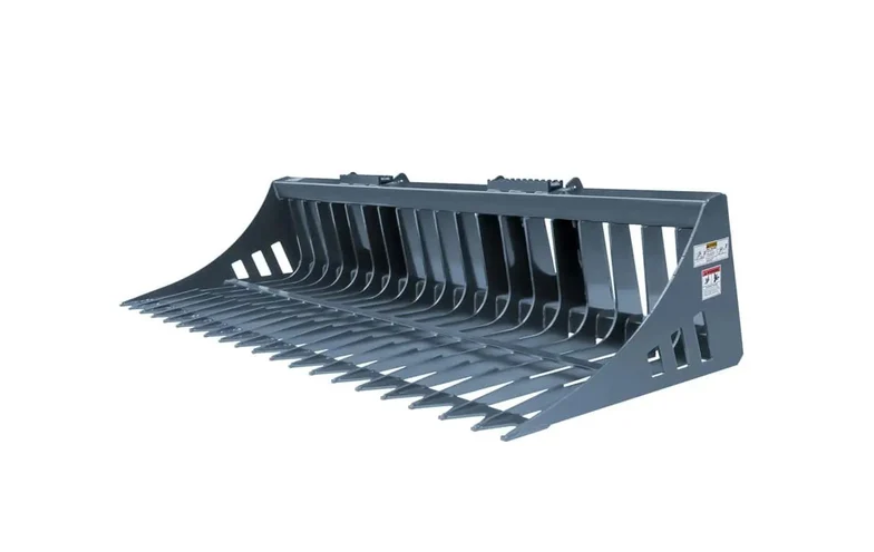
An eighty-four inch skeleton bucket clears stony ground in passes rather than in grabs


Winter rain lifts stone into paddocks that were cleared last year
Every wet season pushes another crop of stone towards the surface of Australian paddocks, and the close of winter is when it becomes visible again. That stone has to come off the working ground before spring cultivation begins, and an eighty-four inch skeleton bucket is the tool most contractors reach for.
The task is unglamorous and it repeats every year, which is exactly why the method matters. Picking stone by hand is possible on a house block and hopeless across a paddock, so the work has to be done by a machine moving continuously rather than stopping to gather.
A skeleton bucket has no upper jaw, and the technique follows from that
It is easy to confuse this tool with the grapples that carry a hinged top clamp, but the two work differently. Nothing closes over the load here, so material is held by the shape of the shell and by the operator keeping it rolled back, exactly as with a solid bucket.
That absence is not a shortcoming. A clamp is what lifts an awkward single object such as a stump or a fallen limb, and it is of no help at all when the task is combing many tonnes of soil and stone that offers nothing to grip.
Width is what turns a slow job into a finished paddock
Eighty-four inches, a little over two thousand one hundred millimetres, is a wide cutting edge for a skid steer. Each pass takes a strip of ground that a narrow tool would need two runs to cover, and the number of passes is what governs how long a paddock takes.
Throughput on this work is counted in hectares rather than in loads. A contractor near Ballarat covers ground in a morning that once took a full day, simply because the width of the cut removed half of the driving from the job.
Scraping and separating happen in the same movement
The tool skims the top of the ground while the frame stays open, so soil and fines fall away as material travels back along the floor of the shell. What remains at the end of the pass is stone, root, and rubbish, already parted from the dirt without a second operation.
That single motion is the whole efficiency argument. Topsoil never leaves the paddock, which matters more in thin Australian country than most operators first expect, and the skeleton bucket is not carrying dirt that would only have to be put back.
A screen processes a heap, while this works the ground itself
The distinction worth drawing is with screening equipment, which stands still and is fed by a loader from an existing pile. That arrangement suits excavation spoil, where material has already been dug and gathered into one place by another machine before sorting begins.
Ground that has never been dug offers no pile to feed. The tool goes to the material instead, working across the paddock surface in a continuous pass, which is why the two sit at quite different points within the same broad task.
Practices that keep a wide skeleton bucket predictable
A wide attachment loaded with stone puts its weight further from the machine than an operator is used to, and stony ground is rarely flat. Most trouble on this work comes from the load rather than from the cutting edge.
- Keep the load low when travelling across slopes
- Match the width to the machine capacity
- Watch for stone rolling off the open frame
- Empty on level ground, never on a bank
What the open shell gives back and what it costs
- Strength: separates and collects in one pass
- Strength: leaves topsoil where it belongs
- Limit: cannot grip a single awkward object
- Limit: wet clay blocks the open bars
Set against a solid bucket, a skeleton bucket gives up the ability to carry soil and returns a load already sorted before it reaches the heap. On stony pasture that exchange is settled before work starts, because nobody wants to cart topsoil off a paddock twice.
Contractors are treating stone as a recurring crop
Across mixed farming country the assumption has changed from clearing a paddock once to combing it every few seasons. Machinery is heavier and faster than it used to be, and a stone left in the ground now costs far more in broken cultivation gear than it did a generation ago.
That expectation shapes the skid steer attachments TMG Industrial supplies to Australian contractors, where separating on the move is treated as ordinary practice.