
Back Pain Is Rising Among Remote Workers — Simple Home Exercises That Help


Back pain doesn’t usually start with an injury.
It starts with a routine.
For many remote workers, the day looks almost identical—same chair, same screen, same position for hours. At first, it’s just stiffness. Then it lingers. Then it becomes something you expect.
That’s the pattern more people are experiencing in 2026. And it’s not random.
It’s the result of movement slowly disappearing from the day.
When Your Workday Stops Including Movement
Remote work didn’t just remove commuting.
It removed all the small movements that used to happen without thinking.
Walking between meetings. Standing while talking. Shifting positions throughout the day.
Now everything happens in one place.
Over time, the body adapts to that stillness. Muscles that should stay active stop doing their job, and others take on more load than they were designed for.
That’s where discomfort begins.
It’s Not Just Posture—It’s Lack of Support
Posture often gets blamed first.
But posture alone isn’t the real issue.
The problem is that the muscles supporting your spine—especially your core, glutes, and upper back—aren’t being used enough. Without that support, the lower back starts compensating.
That’s when pain shows up.
Not because something is damaged, but because something is missing.
Stretching Feels Good—But It Doesn’t Fix the Problem
Most people stretch when their back starts to hurt.
And it helps—for a moment.
But if the muscles that should support your body are still weak, the discomfort comes back.
This is why stretching alone rarely solves the issue.
What your body actually needs is strength in the right places.
The Shift That Changes Everything
You don’t need a new routine.
You need a new pattern.
Instead of long periods of stillness followed by one workout, the body responds better to small, repeated movement throughout the day.
That’s the shift.
Movement stops being something separate—and starts being something built into your day.
What This Looks Like in Real Life
This is where most people overthink it.
They assume they need a full workout session.
In reality, it often starts much smaller.
A couple of minutes of movement between tasks. A short session at some point during the day. Even just standing up and moving before the next task begins.
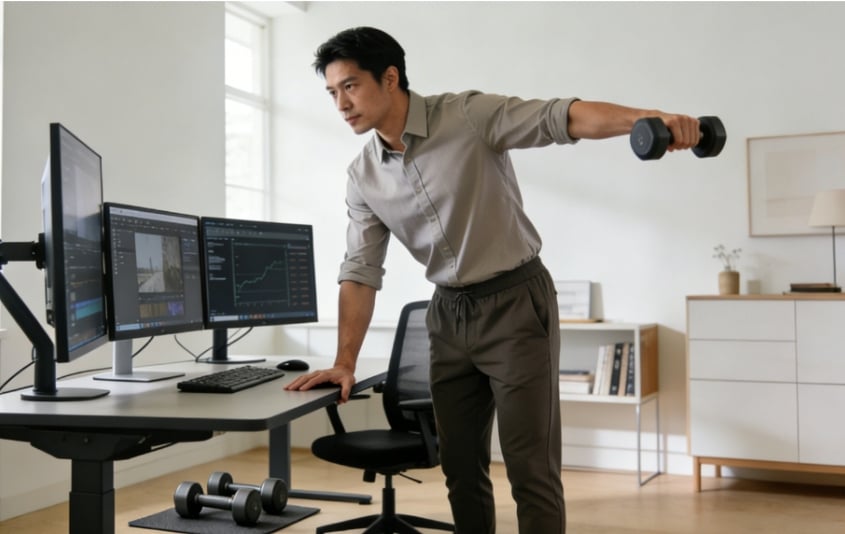
For example, a quick full body dumbbell workout—even just a few controlled reps of squats, rows, and presses—can activate the muscles that have been inactive for hours.
It doesn’t interrupt your day.
It changes how your body moves through it.
The Movements That Actually Help
What matters most is targeting the areas that are being neglected.
Most people benefit from strengthening the lower body, improving core stability, and reactivating the upper back—because those areas directly support the spine.
The key is not doing more exercises.
It’s doing the right ones often enough that your body stops relying on compensation.
Why Short Sessions Work Better Than Long Ones
A long workout once in a while won’t fix a daily problem.
Back discomfort comes from patterns.
And it improves when those patterns change.
Short sessions—done consistently—send a repeated signal to the body. Muscles start engaging again. Movement becomes smoother. The body stops adapting to stillness.
That’s what creates real change.
What You Start to Notice After a Few Days
At first, the difference is subtle.
Then it becomes obvious.
You stand up and don’t think about your back first. Sitting doesn’t feel as heavy. Movements that used to feel stiff become easier.
After a few days, you realize something:
It’s not about doing more.
It’s about not staying still for too long.
The Mistake Most Remote Workers Make
Most people don’t ignore the problem.
They try to fix it—but in the wrong way.
Either they do nothing, or they try to jump into something too intense.
Neither works.
What works is something in between.
Simple, repeatable movement that fits into the day.
Why Your Setup Matters More Than Motivation
Motivation isn’t reliable.
Environment is.
If movement is easy to start, it happens. If it requires effort, it gets delayed.
That’s why having simple home fitness tools nearby changes behavior. Not because they’re advanced—but because they remove the gap between thinking and doing.
No setup. No friction.
Just movement.
Conclusion: Fix the Pattern, Not Just the Pain
Back pain among remote workers isn’t random.
It’s the result of how the day is structured.
And that means the solution is also structural.
By adding short, consistent movement into your routine, activating the right muscles, and making it easy to start, you change how your body feels—without changing your entire schedule.
And once that pattern shifts, the discomfort stops feeling inevitable.
It becomes something you can actually control.