Point of Purchase Marketing Ideas That Actually Work


Have you ever seen products displayed near the checkout counters and had the urge to buy? That’s the magic of POP (Point of Purchase).
Displaying products at strategic locations in retail stores (especially at checkout counters) drives customers who aren’t even familiar with your product to pick it up. Yet, of course, if you display those products appealingly, they catch customers’ eyes.
Whatever product you’re selling in retail stores, you can boost sales by brainstorming point-of-purchase marketing ideas. But what ideas that actually work? Let’s dive in.
What’s Point of Purchase?
First, let’s get to know point of purchase.
In short, Point of Purchase (POP) marketing is about grabbing shoppers’ attention right where they buy. It’s all about turning browsers into buyers with smart displays, impulse-buy items at checkout, digital screens, or endcap displays that highlight deals or new products. The main purpose? To create urgency and a better shopping experience that boosts sales without massive budgets.
So, is it the same as point of sale?
Not really.
Here’s the scoop.
Think of POP as the store’s overall sales pitch, and Point of Sale (POS) as the last-minute, tempting deal just before customers pay.
POP is a broad, in-store marketing approach (aisles, windows, displays) to build interest before the final choice. Meanwhile, POS stands for point of sale (cash register) for quick, impulse purchases and payment processing.
Simply put, POP gets customers interested, and POS seals the deal.
Point of Purchase Marketing Ideas You Would Want to Try
Alright, now back to the main point: What are some great marketing ideas? What are the strategic ideas for point-of-purchase promotion?
Here they are!
- Shelf Talkers & Barkers: Small signs attached to shelves that call out discounts or product benefits.
- Product Bundles: Offer related products in bundles. For example, when customers buy shampoo, they can get a 5% discount on conditioner.
- Digital Displays: Screens that play videos or promotions of your products.
- Counter Displays: Small, attractive displays placed at checkouts to drive impulse purchases.
- Pavement Signs: They are outdoor signs that draw customer traffic with engaging offers.
Combining the 1% Rule in Marketing with POP Ideas
What is the 1% rule in marketing, and how to include the 1% rule in POP marketing ideas?
The 1% rule in marketing is a powerful principle, also known as the “minimum viable effort” or “continuous improvement” approach. The rule suggests that, instead of attempting large, risky overhauls, businesses focus on achieving a modest 1% improvement each day or week.
Here’s how to integrate the 1% rule in POP marketing.
Merchandising Tweaks
Adjust your product’s shelf height or add a small, eye-catching display near the register.
Quick-Decision Prompts
Create a small sign offering a “buy one, get 10% off the second” deal or even a loyalty stamp for a quick scan.
Strategic Placements
Place multiple products in eye-catching endcap displays, shelf displays, or custom display packaging boxes. Then, strategically position them to streamline checkout.
But wait, different products have different characteristics. Surely, you’ll need other ideas of strategic product placements.
Here are some examples.
For an enticing snack display, focus on eye-catching design (bright colors, bold graphics). The strategic placements would be near checkouts, entrances, or in endcaps.
Remember to organize those snacks by type (puffed, bagged, etc.). Then place bestsellers at eye level and create themed seasonal displays to maximize appeal and sales.
Is it possible to use POP marketing for luxury products, like jewelry? Of course!
Here’s how.
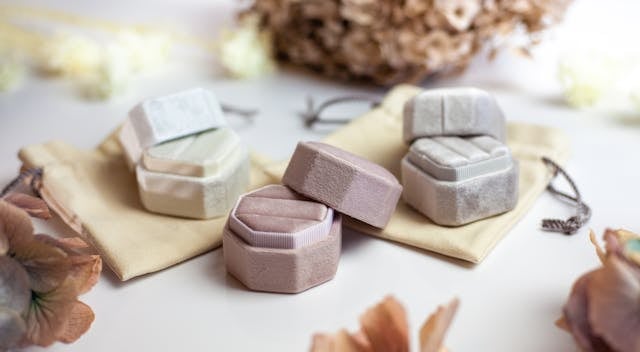
Consider displaying your valuable jewelry pieces in exclusive custom jewelry boxes for business. Here, you should ensure that the box size and layout are engaging to be seen. You can also consider using multi-tiered displays, rotating carousels, or individual pedestals.
The final touch? Add lighting (LEDs) and mirrors to add sparkle—an attention-grabbing jewelry display that guides the customer’s eye.
Improve Slowly (but Sure)
Make small, almost unnoticeable improvements at the point of sale to gently (yet convincingly) influence customers’ choices.
What are the 7 Ps of Retail Marketing?
Speaking of POP marketing ideas, we shouldn’t ignore the 7 Ps of retail marketing, right? They’re all connected. How?
So, in the 7 P’s of retail marketing, we have:
- Product: What are you selling? Think about the product’s features, quality, branding, and design that meet customer needs.
- Price: Set the right price that balances cost, competition, and perceived value for customers.
- Place: Where and how customers buy; ensure they can easily access your products (again, through POP displays).
- Promotion: Translate your business value through advertising and promotions.
- People: Train your staff to provide an exceptional customer experience.
- Process: Ensure customers have a smooth flow from purchase to delivery, including checkout and returns.
- Physical Evidence: Elements such as store design, packaging, and displays should all build brand trust.
Wait, now what about the 5 Ps of retail marketing? How to include them in POP marketing?
Basically, the 5 Ps of retail marketing are the initial elements of the overall marketing mix that include Product, Price, Place, Promotion, and People.
The extra two Ps (Process and Physical Evidence) in the modern 7 Ps of retail marketing aim to help businesses manage the intangible aspects of services that the traditional model didn’t cover.
In other words, the 5 Ps model provides a strong foundation for any marketing strategy. Meanwhile, the 7 Ps model offers a sturdier, holistic framework, especially when the customer experience and service delivery are central. The extra Ps ensure that a business can plan and evaluate every aspect of its offering, from initial product design to the final service interaction and the environment in which it occurs.
In POP marketing, the 7 Ps approach helps ensure a more engaging and effective POP display by considering every touchpoint of customer experience right up to the final purchase.
Summing Up
No doubt, displaying products at strategic locations in retail stores (especially at checkout counters) encourages customers who aren’t familiar with your products to pick them up.
In fact, you can boost sales by brainstorming point-of-purchase marketing ideas, such as shelf talkers & barkers, product bundles, digital displays, counter displays, and pavement signs.
Apply the 1% rule in marketing: aim for a modest 1% improvement each day or week (slowly but sure). Also, don’t forget to integrate the 7 Ps of retail marketing to get the best results from your POP display.
Well, then, I’m sure you’re now ready to level up your POP marketing!