
Sign Installation Company Networks Going National | NY IL TX


From Chicago to Austin: Why Local Sign Installation Company Networks Are Going National
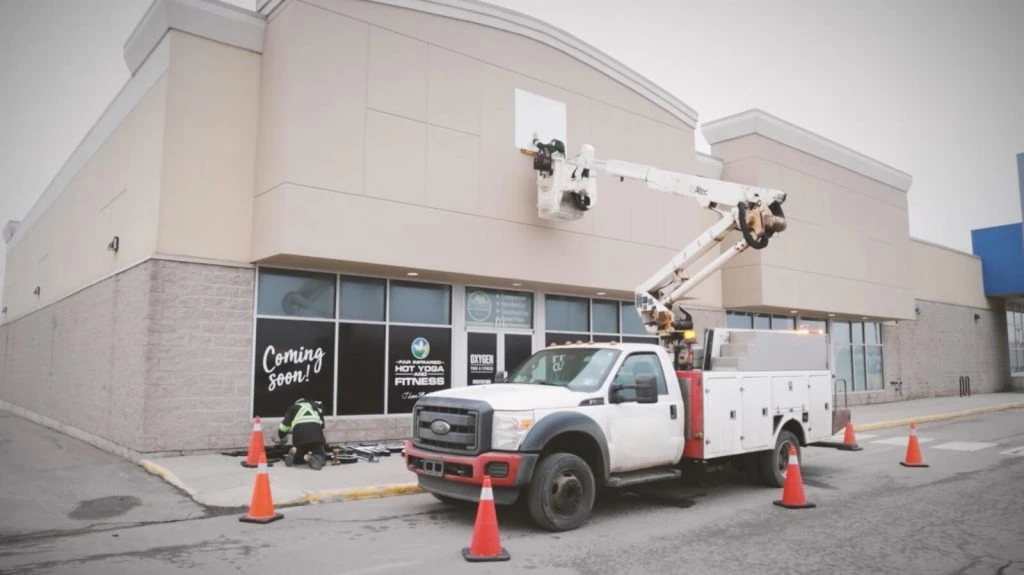
At 2 a.m. on a commercial corridor, the work looks the same in any city: a bucket truck, a quiet crew, a laminated permit set, and an install window that closes before morning traffic returns. What’s changing is who’s behind the crew. The sign on the work order might still read like a local shop—but increasingly, it’s part of a multi-state service network built to cover New York, Illinois, and Texas under one operating standard.
For print shops, property managers, franchise operators, and general contractors, this shift is reshaping the “sign installation company” decision. You’re no longer just hiring labor. You’re selecting a delivery system: permitting, scheduling, compliance, and warranty service—at scale.
This article explains why regional firms are expanding into national footprints, what consolidation actually means on the ground, and how buyers should evaluate a national sign installation company versus a purely local provider—especially across NY / IL / TX.
Context: What’s happening in New York, Chicago, and Austin
Three forces collide in these markets: regulatory complexity, multi-location growth, and brand standardization.
New York is permitting-heavy. NYC DOB states that signs generally require permits, and notes specific exceptions (e.g., smaller non-illuminated signs under a size threshold), while illuminated signs require permits and are handled through DOB NOW. That reality pushes buyers toward installers who can manage filings, revisions, inspections, and closeouts—not just lift equipment.
Chicago is similarly formal. The City of Chicago publishes sign-permit requirements and separates sign permits from electrical licensing requirements for wiring and equipment regulated under the Chicago Electrical Code. In practice, a “simple” storefront project can become a sequencing problem: landlord approvals → sign permit → electrical permit → scheduling the right licensed parties → inspection timing.
Austin is growing fast, but it’s not a free-for-all. The City of Austin states that it requires sign permits for outdoor signage under its Land Development Code and provides a defined application process. For expanding brands, Austin becomes the test of whether a provider can keep speed without slipping on compliance.
Across all three: the buyer is increasingly shopping for a signage company that can behave like an operations partner—especially when the “sign” is part of a broader rollout (rebrands, multi-site conversions, tenant improvement packages, EV corridor build-outs).
Key trends driving the move from local to multi-state networks
National accounts changed expectations for signage delivery
Multi-unit operators want one scope, one spec, one billing lane—and consistent execution across cities. That’s why “national accounts” models have grown: centralized coordination with local production/installation capacity, often including site surveys, permitting management, and standardized implementation.
For buyers, this is the hidden reason behind the rise of the American sign installation company brand story: it’s not patriotism—it’s procurement. The customer doesn’t want 40 vendors.
Consolidation isn’t theory; it’s a strategy built for fragmented services
Installation is a classic fragmented field: many small operators, uneven documentation, variable compliance maturity. Consolidation (including “roll-up” plays) is a known strategy in fragmented markets—acquire capability, standardize operations, then sell a unified footprint.
In signage, the logic is straightforward:
- Customer demand: multi-site rollouts, brand refresh cycles, seasonal campaigns
- Operational leverage: shared permitting playbooks, dispatch, training, safety, QA
- Commercial leverage: national pricing frameworks + regional labor execution
Installer networks are being formalized—because national companies need local capacity
The International Sign Association explicitly describes programs designed to connect local installers with national sign companies that need installation capacity. That’s an institutional signal: demand for distributed installation coverage is not occasional—it’s structural.
Compliance is becoming part of the product
In NY / IL / TX, compliance isn’t paperwork; it’s schedule control. Permitting, electrical requirements, landlord rules, and inspection pathways determine whether a storefront opens on time.
- NYC DOB emphasizes permit requirements and separate handling for illuminated signs via its systems.
- Chicago outlines sign permits and electrical licensing expectations.
- Austin publishes a dedicated sign permit process for outdoor signage.
The nationalization trend follows the money: delays cost more than cranes.
Product scope widened: indoor + outdoor + wayfinding + service cycles
A decade ago, many buyers treated installation as a one-and-done event. Now it’s closer to facilities maintenance:
- indoor signage company needs (ADA, wayfinding, wall graphics, lobby ID)
- outdoor signage company needs (channel letters, cabinets, pylons, monuments)
- ongoing: lighting repairs, storm damage, tenant changeovers, compliance updates
That shift favors providers with dispatch systems and multi-city technician access—because recurring work is predictable revenue.
Pricing and the economic reality: why “national” can cost less (or more)
Pricing is messy because buyers conflate three different things:
- Installing an existing sign (labor + equipment)
- Fabrication + installation (full project)
- Program rollout (multi-site management, surveys, permitting, coordination)
Consumer-style averages can look small because they often describe basic installs; Angi lists an average commercial sign installation cost in the hundreds for simple jobs, while also citing per-square-foot ranges for custom/illuminated work. Meanwhile, full signage packages (fabrication + install) for channel letters and pylons commonly move into five figures.
Realistic 2025 cost ranges (typical project bands)
| Category (common scope) | What’s usually included | Typical range (installed) |
| Basic install of small/standard signage | Labor, basic mounting, limited equipment | ~$181–$804 (simple installs) |
| Channel letters (common storefront set) | Fabrication + lighting + install (varies by size/spec) | ~$4,000–$20,000 |
| Monument sign | Structure/materials + install (site work varies) | ~$5,000–$15,000+ |
| Pylon sign | Engineering + footing/site work + permitting + install | ~$8,000–$200,000 (wide variance by height/spec) |
What drives cost in NY / IL / TX
- Permitting + revisions: time, drawings, resubmittals (especially NYC/Chicago)
- Electrical scope: licensed work, inspections (NYC illuminated signage; Chicago electrical licensing)
- Access + equipment: crane vs bucket vs interior lifts (cost step-change)
- After-hours windows: common in dense corridors to avoid traffic disruption
- Site conditions: façade materials, structural needs, landlord constraints
Why national networks sometimes price sharper: they can amortize project management and negotiate equipment utilization across markets. Why they sometimes price higher: they’re selling process, compliance control, and warranty response time—not just labor.
Decision-making: how B2B buyers should choose the right model
If you’re a print shop owner, property manager, GC, or multi-location operator, don’t start with “sign suppliers near me.” Start with risk and repeatability.
1) Separate “fabrication partner” from “installation system”
You can buy signs from strong fabricators and still fail on execution if installation is inconsistent. The real question is whether the installer runs a documented system: surveys, measurements, photo logs, permit tracking, pre-flight checklists, closeout packets.
2) Ask how they handle permitting across NY / IL / TX
A credible provider should speak clearly about:
- NYC DOB workflow for sign permits and illuminated signs
- Chicago sign permit process and electrical licensing boundaries
- Austin sign permit requirements and submission steps
If you hear vague language here, your schedule will pay for it later.
3) Evaluate install QA like you evaluate production QA
Ask for:
- photo documentation standards (before/during/after)
- fastener and attachment method standards
- electrical test/verification approach (as applicable)
- punch-list + warranty response SLAs
This is where a signage company in USA positioning becomes real: not geography, but operational control.
4) Match provider footprint to your rollout pattern
- Single location, low compliance risk: local specialist can be ideal
- Multi-location, time-sensitive brand refresh: a national sign installation company model often wins
- Mixed indoor/outdoor + service needs: prioritize dispatch + maintenance capability
Mini case study: two scenarios buyers actually face
Scenario A: Print company managing a multi-site retail refresh (Chicago → Austin)
A regional print company wins a campaign: new exterior IDs, window graphics, and parking-lot wayfinding for 18 sites—8 in Illinois, 10 in Texas—on a fixed opening schedule.
Constraints
- Landlord approvals vary by center
- Some sites need illuminated updates (electrical coordination)
- Install windows are nights/weekends
- The print company’s reputation depends on install quality, not print quality
What works
- A standardized site survey template, identical measurement protocol, centralized scheduling
- Clear division: fabrication stays with the print partner; installation runs through a coordinated network
- A single escalation path when a city correction letter or landlord revision hits
Result: fewer change orders, fewer missed openings, and a cleaner closeout packet for the client’s facilities team.
Scenario B: Property management in New York needing reliable “real estate sign post company” capacity
A property manager oversees multiple buildings and needs recurring installs: building IDs, tenant panels, directional signs—plus rapid replacements after weather events.
Constraints
- NYC permitting sensitivity (especially illuminated signage)
- Tight access rules and limited staging
- Recurring work, not one big job
What works
- A service-driven installer with documentation, repeatable mobilization, and permit literacy
- A maintenance agreement mindset, not transactional quoting
- A vendor that can also act as a street sign installation company partner when site wayfinding expands
Where Easy Way Install fits
Easy Way Install Sign Installation company positions naturally in the space where buyers need consistent execution across NY / IL / TX: disciplined installs, coordinated scheduling, and a process that respects permitting realities and multi-site operational constraints.
If you’re a print shop scaling beyond one metro, or a brand rolling out signage across states, using a provider built for multi-market delivery reduces the two biggest sources of pain: schedule drift and compliance surprises.
Conclusion: the industry is moving from “local labor” to “network operations”
Local sign installation isn’t disappearing. It’s being reorganized—into systems that can support multi-location brands, permitting complexity, and service cycles that look more like facilities operations than one-time projects.
For buyers, the practical shift is this: choose the provider model that matches your risk profile. If opening dates, compliance, and repeatability matter, evaluate the installer like an operations vendor—not like a subcontractor.
CTA: Book a consultation with Easy Way Install to map your rollout scope, permitting pathway, and installation plan across New York, Illinois, and Texas.
FAQ
How much does a sign installation company cost in New York?
Costs depend on whether you mean installation-only or a full fabricated sign package. Simple commercial sign installs can fall in the low hundreds, while full channel letter projects commonly reach five figures depending on size, lighting, and permitting.
Do I need a permit for outdoor signage in Austin?
Yes—Austin states it requires sign permits for outdoor signage and provides a defined process tied to the Land Development Code.
What’s the difference between a local signage company and a national sign installation company?
Local providers often optimize for single-market speed and relationships. National networks optimize for standardized surveys, centralized scheduling, consistent QA, and multi-city permitting coordination—especially for rollouts.
How far in advance should I book sign installation in Chicago?
If permits and electrical work are involved, lead time should account for city review cycles, landlord approvals, and licensed scheduling. Chicago’s published sign permit and electrical licensing requirements make early planning a practical necessity.
What should a print shop ask before hiring an outdoor sign installation company near me?
Ask for: survey methodology, permitting responsibility, equipment plan (bucket/crane), electrical coordination approach, QA documentation, and warranty/service response terms. Also confirm how they handle multi-site scheduling and closeout packets.
Are illuminated signs treated differently in NYC?
Yes. NYC DOB indicates illuminated signs require permits and are handled through DOB NOW workflows, which adds compliance and scheduling steps beyond a basic non-illuminated install.