
How Overweight Truck Permits Impact Delivery Timelines


A load that’s ready to roll doesn’t always move as soon as the truck is loaded. Once weight enters the picture, the permit process alone can add days to a delivery window that looked straightforward when the job was quoted, and carriers who don’t budget for that gap often end up explaining the delay to a client who was promised a specific date.
Structural Review Takes Longer Than a Dimensional Check
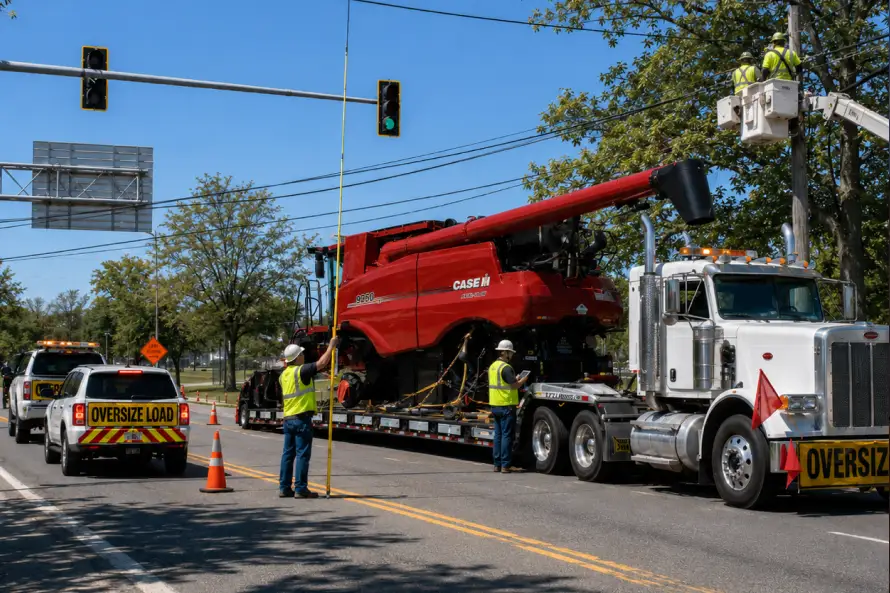 A standard oversize permit mostly confirms that a load fits within a state’s width, height, and length allowances, which is a relatively quick comparison against posted limits. An overweight application asks a harder question: can every bridge on the route actually hold this much weight? That means checking structural ratings on each crossing rather than just measuring clearance, and that kind of review takes real time on the state’s end, not just a quick database lookup. States with older infrastructure or a high number of restricted bridges along common freight corridors tend to take longer still, since more structures usually means more individual checks before anything gets approved.
Multi-State Routes Stack Processing Time
Each state runs its own review independent of the others, so a route crossing several states means several separate approval timelines running in parallel — or sometimes in sequence, depending on how a carrier submits the applications. A load that’s cleared in one state isn’t automatically cleared in the next, and if a bridge issue turns up partway through the route, it can send the carrier back to revise the plan for states that were already approved. This is one of the more overlooked reasons multi-state overweight hauls take longer than carriers initially budget for — the delay doesn’t always show up in the first state’s processing time, it shows up when a later state’s review flags a structure the earlier plan didn’t account for.
Axle Reconfiguration Can Add Days Before the Application Even Goes In
Sometimes the weight itself isn’t the problem — the distribution is. If axle spacing doesn’t meet a specific bridge’s requirements, the carrier may need to adjust the trailer configuration or add axles before the overweight truck permit application can even be submitted with accurate numbers. That adjustment happens before the state review starts, which means it adds to the timeline on top of whatever processing time the permit itself requires. Carriers who don’t catch this early, and submit with the original configuration, often get the application bounced back for correction instead of catching the issue upfront.
A Route Change Mid-Process Resets Part of the Clock
If a state flags a bridge that can’t handle the load, the fix usually isn’t a quick edit — it’s a new route through an alternate crossing, and that revised route needs its own review before the permit can move forward. A few things that commonly trigger this kind of reset:
- a restricted bridge discovered only after the initial route was submitted;
- seasonal weight restrictions that weren’t in effect when the route was first planned;
- a state requiring additional engineering documentation for a specific structure before approval.
Each of these pushes the timeline out further, and because the carrier usually doesn’t know a route change is coming until the state flags it, it’s difficult to plan around in advance without padding the schedule from the start.
Superload Territory Adds Its Own Delay
When a load’s weight crosses into superload classification, the review process shifts from a standard check into a full engineering analysis, and that alone can add a week or more depending on the state and the complexity of the route. Carriers who assume a heavy load will process on a standard overweight timeline sometimes find out only after submission that it actually qualifies as a superload, which restarts the clock under a slower review process.
Building the Timeline Around the Permit, Not Around the Load
Because weight review depends on structures rather than simple measurements, the permit timeline for an overweight load is genuinely harder to predict than for a standard oversize one. Carriers who submit applications with a buffer for the possibility of a route revision, and who verify axle configuration before filing rather than after a rejection, tend to avoid the worst of the delays. Treating the permit process as part of the delivery schedule itself, rather than a formality that happens alongside it, is usually what separates predictable timelines from last-minute scrambling.